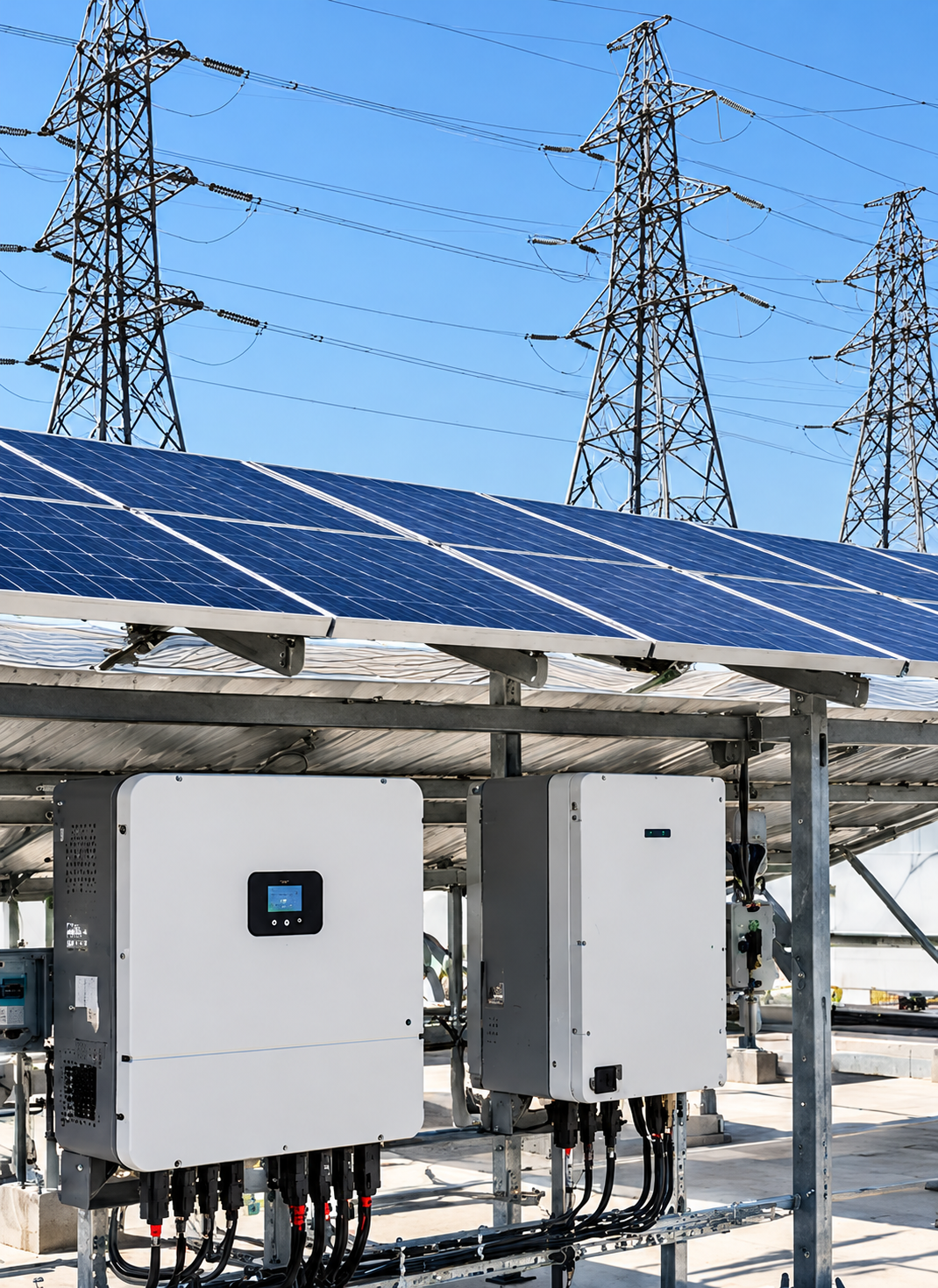
An on-grid system connects straight to the MSEDCL grid: no battery, no backup. What you generate offsets what you draw. What you don’t use, you export through net metering. It’s the system most SVPL industrial clients run, and for good reason: no battery means lower upfront cost and nothing to maintain or replace every few years.

Ideal for:
Sites with no DISCOM access – remote land, agricultural pump sets far from the grid, or standalone structures where running a new line costs more than going off-grid entirely.
Ideal for:
Factories and businesses with reasonably stable grid supply, where the goal is cutting the bill, not running through outages. If your power cuts are rare or short, on-grid alone usually makes the strongest financial case
Panels generate during the day. Your load draws from that generation first. Anything surplus flows to the grid and gets credited against your MSEDCL bill under net metering.
An on-grid solar system is connected directly to the MSEDCL grid with no battery storage. Electricity generated is used on-site first, and any surplus is exported to the grid through net metering, which credits it against your bill.
Yes, on-grid is the standard configuration for MSEDCL net metering, for both LT and HT industrial and commercial consumers, up to the sanctioned load cap.
If the grid goes down, an on-grid system shuts down with it: by design, for safety, so it doesn’t feed power back into a line utility crews may be working on. No grid, no output, battery or not.
We’ll reply within one business day with next steps, or the name of someone better suited to help.
himanshu_ceo@svplsolar.com
+91 9518798020
Jalgaon, Maharashtra, India
Most factory owners we speak to have never run the real numbers. We run them honestly — with your actual tariff slab, your actual load profile, and a conservative payback projection. No hype. No pressure. No obligation.
Free · No obligation · Response within 24 hours
Jalgaon · Nashik · Aurangabad · Nagpur · Mumbai